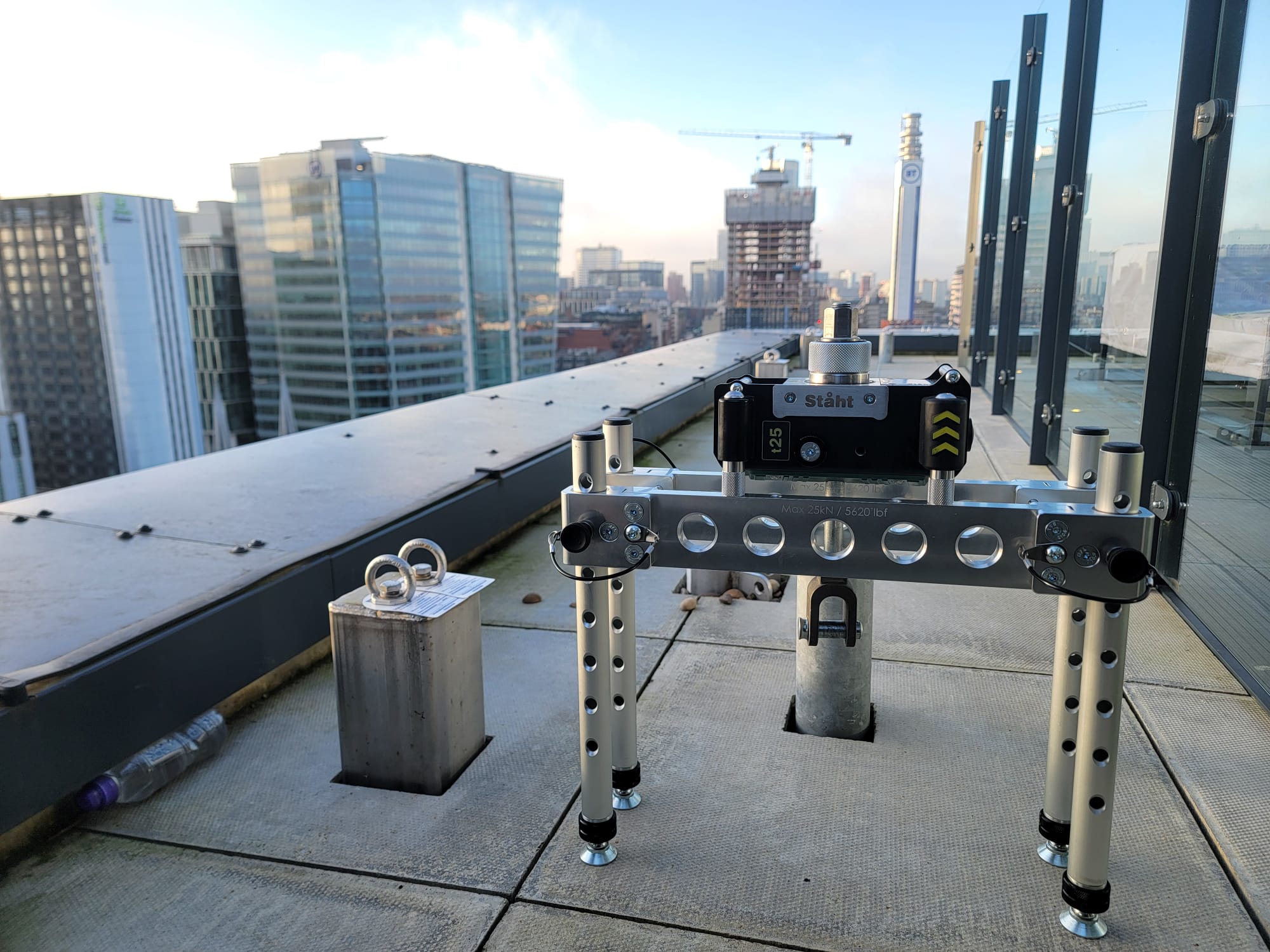
Pull Testing Regulations
A practical guide to the UK standards governing anchor and fixing pull testing — BS 8539, BS 7883, BS EN 795 and NASC TG4 — and what they mean for safe, compliant work at height.
Why pull testing is regulated
Anchors and fixings hold up the things that keep people safe — fall-arrest eyebolts, scaffold ties, façade brackets, building services and temporary works. When an anchor fails, the consequences are rarely trivial. UK standards exist to make sure that the right anchor is selected, installed correctly, and verified by test where its performance cannot be assured by design and product data alone.
The word “pull test” is used loosely on site to describe several different procedures that answer different questions. Getting the distinction right matters: the wrong test produces the wrong evidence, and an installation that looks tested may not actually prove the duty being relied upon. This guide sets out the main regimes, when testing is required, and what good evidence looks like.
Three tests that get called “pull tests”
Under BS 8539 the three procedures below answer different questions. Choosing the correct one is what turns a pull on an anchor into meaningful, defensible evidence.
| Test type | Question it answers | Destructive? | Typical use |
|---|---|---|---|
| Proof / test-load | Was this anchor installed correctly to a defined load? | No | ETA-approved anchors in known substrate — verifies installation quality |
| Allowable load | What safe working load can this anchor actually achieve? | Sometimes | Non-ETA materials or conditions outside the anchor's assessment |
| Ultimate / pull-out | At what load does this anchor or substrate fail? | Yes | Establishing or investigating resistance — will damage the substrate |
How much do you have to test?
There is no single universal figure — sampling depends on the standard, the anchor, the substrate and the project specification. The values below are widely used starting points; always confirm against the current standard and the specifier's requirements for your job.
| Context | Indicative sampling | Indicative proof load |
|---|---|---|
| BS 8539 proof testing | Commonly around 1 in 25 to 1 in 40 anchors | Up to ~1.5× the recommended (working) load |
| BS 7883 fall-protection anchor | Each installed anchor device proof tested | 6 kN for most devices (except cavity constructions) |
| NASC TG4 scaffold ties | Per the guidance and project spec | Required test load per substrate and design |
When is testing mandatory?
Under BS 8539, testing is not optional where anchor performance cannot be assured through design, product data and controlled installation alone. The requirement is driven by risk, not preference. Where an anchor with a relevant ETA is installed by competent, supervised installers in a known substrate, the code recognises that testing may not be needed. In practice, the situations below frequently tip an installation into mandatory verification.
Test when any of these apply
- Existing structures or unknown base materials
- Refurbishment work and services installations
- Installation outside the anchor's ETA conditions
- Non-ETA-approved substrates where design values don't apply
- Safety-critical and fall-protection duties
- Specifier or principal designer requires proof evidence
What good evidence looks like
A test is only as useful as the record it leaves behind. Whatever the standard, an auditable, traceable record is what demonstrates compliance at handover and stands up if performance is ever questioned.
Capture on every test
- Anchor type, location and base material
- Required test load and achieved load
- Pass / fail outcome against the specified criterion
- Equipment ID and current calibration certificate
- Date, tester identity and signature
- Photos and any movement or anomalies noted
Who is allowed to carry out testing?
How often should fall-protection anchors be re-inspected?
Does calibration of the test equipment matter?
Is a proof test the same as a pull-out test?
What is the difference between BS 8539 and BS 7883?
What proof load is used for fall-protection anchors?
How many anchors do I need to proof test under BS 8539?
Do ETA-approved anchors still need testing?
What equipment do I need to carry out pull testing?
Get equipped
Need the right kit to test to standard?
Staht designs and manufactures BS-compliant digital pull testers with data logging, Bluetooth and UK-based calibration support. Talk to our team about the right setup for your testing.